
Osage Projected Versus Actual Release
A projected, anticipated, conditional, or parole-eligibility date answers when a future legal milestone may occur under the current calculation. An actual release date records when a named agency ended custody. The two can differ. Credits can change, a judge can amend a sentence, another agency can lodge a detainer, or release processing can continue after a court order.
A pretrial detainee at the Osage County Law Enforcement Center / Corrections Facility has no sentence-based release date. Bond may be set, modified, satisfied, or denied, and other warrants can prevent checkout. The county says bonds are set within 48 hours, but that statement is not a promise of release within 48 hours. Setting bond, satisfying it, clearing holds, and processing the person out are separate steps.
- Projected date
- A current agency calculation that may change.
- Parole eligibility
- The point when an eligible sentence may be considered for parole, not a guaranteed exit date.
- Conditional release
- A milestone under older indeterminate sentence rules, subject to the governing statute and credits.
- Discharge
- The end of the identified correctional sentence or supervision authority.
Find Osage Inmate Release Dates
Start by deciding whether the person is in county jail, Kansas state custody, or another system. KASPER is not an Osage County jail roster. A person who bonded out locally may never appear there. Conversely, a person can leave the county jail by transfer and appear in KASPER without having entered the community.
- Check the Osage County criminal case in the Kansas District Court Public Access Portal. Read the sentence, jail credit, bond orders, later journal entries, and whether terms are concurrent or consecutive.
- For county custody, call the jail at 785-828-4991. Ask whether the person is still held and, if sentenced locally, which court and jail-credit record controls the estimate.
- For a Kansas prison sentence, accept the KASPER disclaimer and search by name or KDOC number. Match identity and open the full record.
- Read each date label. Separate anticipated guidelines release, parole eligibility, conditional release, sentence expiration, and any actual movement or discharge date.
- Check for another case, detainer, revocation, or later admission. A date tied to one sentence may not end all custody.
- For documentary proof, request the relevant jail release entry or KDOC movement, release, or discharge record.
The Osage County released inmate search gives the full custody-chain workflow. Preserve the exact status, date label, agency, record number, and access date. A screen copied without its label can turn an eligibility date into a false claim of release.
When records disagree, first ask what each date measures. The court may show a sentence date or a signed release order. KASPER may show an anticipated guidelines date calculated from the controlling sentence. The jail may record the actual checkout later, after staff clear holds. None of those sources must be wrong merely because the dates differ. Preserve the labels, identify the responsible agency, and seek the movement or disposition record that connects them.
KASPER Osage Release-Date Fields
KASPER is the Kansas Adult Supervised Population Electronic Repository. It covers people associated with KDOC-operated or KDOC-funded programs, not every county booking. The search form includes name, alias, KDOC number, conviction county, supervision county, facility, location, birth and identity fields, and supervision type. Open the individual record rather than relying on the result line.
The KDOC public-records brochure identifies sentence fields that can include the individual and controlling sentences, sentence-begins date, anticipated guidelines release date, parole eligibility, conditional release, and sentence expiration. It also describes facility movements, dates, parole office, and supervision level. “Controlling sentence” means the sentence structure that sets the operative term when several terms exist.
| KASPER field | How to read it |
|---|---|
| Anticipated guidelines release | A current calculation for an applicable guideline sentence |
| Parole eligibility | A review milestone for an eligible indeterminate sentence |
| Conditional release | A separate statutory milestone in older sentence structures |
| Sentence expiration | The calculated end of the identified term, subject to the record context |
| Parole or postrelease status | Prison confinement ended while KDOC authority continues |
| Discharged | The KDOC obligation shown by that record ended |
The official KASPER interface is shown on the KDOC search source.
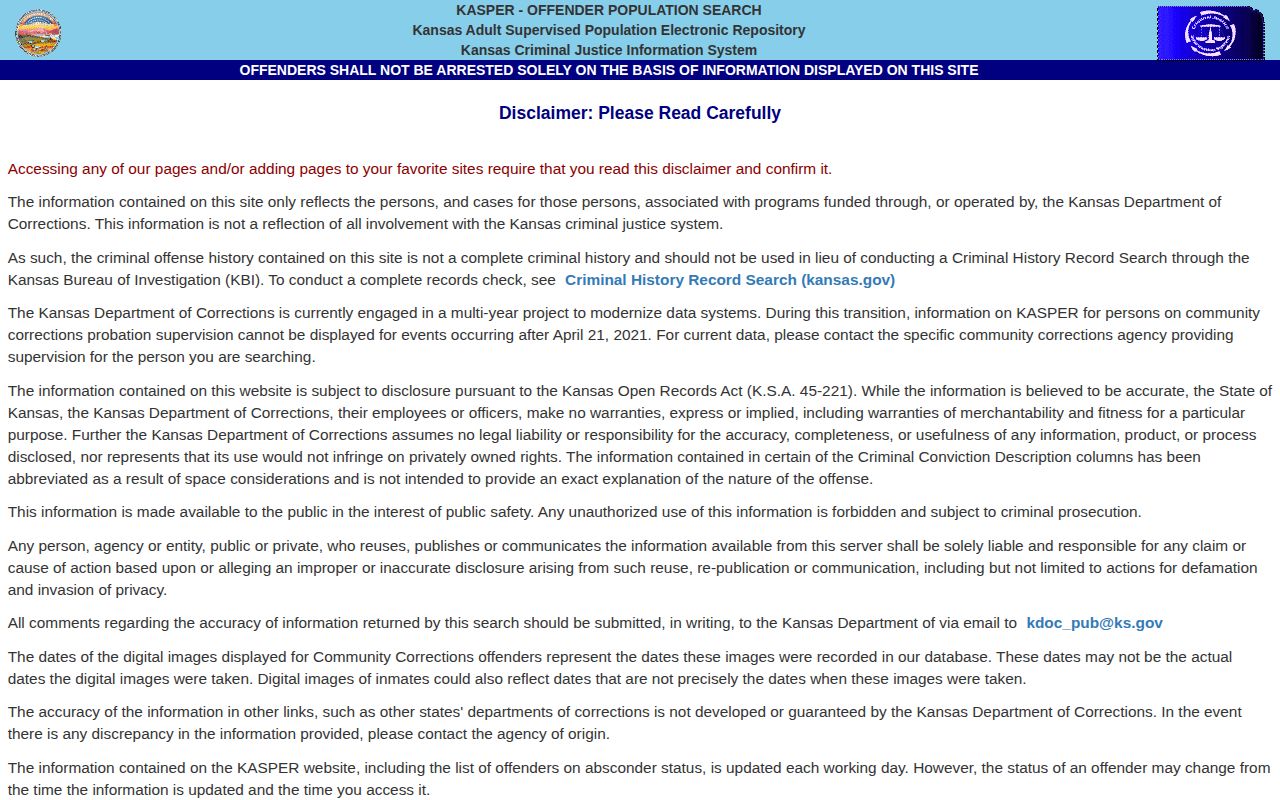
The search fields help narrow the correct Kansas record, but the full record and its exact date labels must be reviewed before drawing a release conclusion.
KASPER’s disclaimer adds two timing limits. Public data, including its absconder information, updates each working day, so a new event may not appear at once. During modernization, Community Corrections probation events after April 21, 2021 are unavailable in KASPER. An Osage County court-probation question therefore belongs with the case docket and Fourth Judicial District Community Corrections, not a projected state-prison release calculation.
Kansas Good Time for Osage
K.S.A. 21-6821 authorizes KDOC good-time rules for guideline sentences and limits credits subtracted from the prison portion. For crimes committed on or after July 1, 1993, the statute provides a general maximum of 15 percent. It provides 20-percent limits for listed groups: nondrug severity levels 7 through 10 committed on or after January 1, 2008; drug levels 3 through 4 committed from January 1, 2008 through June 30, 2012; and drug levels 3 through 5 committed on or after July 1, 2012.
The 15-percent rule produces the common “serve 85 percent” shorthand. It is not universal. Credits must be earned and may be withheld, forfeited, or restored. Offense level, offense date, exclusions, consecutive sentences, jail credit, and later court action all matter. The statute also allows up to 120 days of program credit for statutorily eligible lower-level groups after successful completion of specified education, vocational, treatment, or risk-reduction programs.
Some sexually violent or sexually motivated cases have special treatment in which good time removed from the prison portion can be added to postrelease. Multiple-sentence rules and program exclusions also change the calculation. For these reasons, a KASPER or KDOC calculation is safer than subtracting a percentage from a sentence at home.
Note: good time changes a calculated prison term within the law; it does not create an actual release record before custody ends.
Older Osage Sentence Date Rules
Older indeterminate sentences use a different framework. K.S.A. 22-3717 addresses parole eligibility, conditional release, postrelease, and varied exclusions based on the crime, offense date, and sentence form. General indeterminate parole eligibility is the minimum less lawful good time, but life, off-grid, class A, mandatory, and other specialized terms have their own rules.
K.S.A. 22-3725 contains a good-time table for crimes committed before July 1, 1993. It expressly does not apply to later crimes. Its one-half concepts must not be applied to a modern guideline case. KDOC’s release process explanation distinguishes determinate guideline sentences, which move to postrelease after the prison portion less retained credit, from indeterminate cases that may involve parole eligibility and conditional release.
Why Osage Release Dates Change
A projected date is only as stable as the facts behind it. The court’s controlling sentence, jail credit, concurrent or consecutive structure, offense date, and agency calculation form the starting point. Later events can move the date in either direction.
| Changing factor | Effect on the date |
|---|---|
| Corrected sentence or journal entry | Changes the controlling legal term |
| Jail-credit revision | Adds or removes credited days |
| Consecutive case or detainer | May keep the person confined after one term ends |
| Good-time action | Credit can be earned, withheld, forfeited, or restored |
| Eligible program credit | May reduce the calculation within statutory limits |
| Discipline | Can cause lawful credit loss |
| Parole Board action | Affects an eligible indeterminate case but may set a later effective date |
| Revocation or new custody | Can create a new admission or calculation |
| Administrative recalculation | Updates the date when source facts change |
A detainer is a request or hold from another authority. It can keep a person confined or cause an immediate transfer when Osage County or KDOC custody ends. Thus, one agency’s release date may be the next agency’s intake date.
Parole action needs equal care. For an eligible indeterminate sentence, a favorable Board decision can still carry a later effective date and conditions. A hearing date is not the release date. Modern determinate guideline sentences generally move to mandatory postrelease after the prison portion rather than waiting for a discretionary parole grant. Read the sentence era and the exact KASPER label before using either model.
Osage County Jail Date Calculations
County-jail sentences require the Osage sentencing order, local jail-credit calculation, holds, and actual release processing. Do not apply KDOC’s state-prison 15-percent rule to a county term. Ask the jail and court how credit was calculated for that sentence.
A person held before trial has no computed sentence end. Bond can authorize release while the case continues, but another warrant or agency hold may block community exit. A judge’s order proves what the court authorized. The jail event proves when Osage custody ended. If the facility returns a person it housed for another agency, that is a transfer even if Osage’s local software records an outbound “release.”
Confirm Osage Actual Release Dates
For county custody, confirm the date and disposition with the Osage jail and the court. For state custody, compare KASPER with KDOC movement or discharge records. If the record shows parole or postrelease, prison confinement ended while state supervision continued. If it shows discharge, check the status date and later history before treating KDOC authority as complete.
VINELink Release Check can provide a participating county-jail alert, but Kansas VINE excludes KDOC prison offenders. A release alert can also reflect a transfer. Use it as notice to read the event and contact the facility, not as proof that a projected date became a community release.
For formal proof, request the record created by the agency that performed the event. An Osage Sheriff release entry should include the custody-ending date and disposition when releasable. KDOC can supply applicable movement, release, or discharge information. Match each record to the right person and sentence, then check for a receiving agency or later admission. Record the source and access date. That final step distinguishes release from one custodian from the end of all custody.
Public Record Search
Sponsored Results